
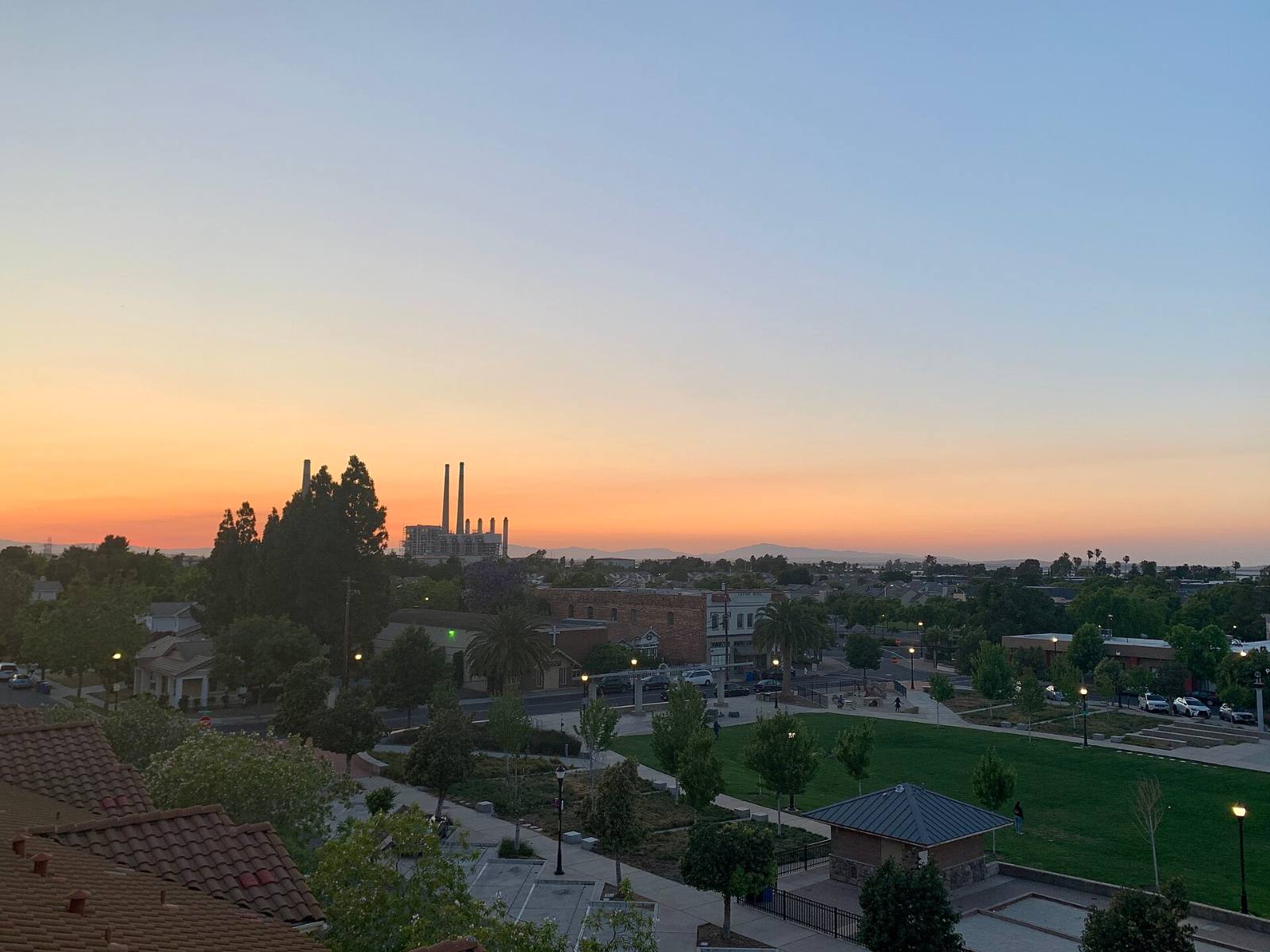
Photo above: John Buckley Square in Old Town Pittsburg at dusk, with power plant stacks in the background, 2023. Armenshirazd, CC BY 4.0, via Wikimedia Commons.

The county’s Hazardous Materials Program lists 9 facilities in Pittsburg under the state’s chemical accident prevention program, CalARP. Four are on Loveridge Road, three of them on the Corteva site, and two are Calpine power plants. None is covered by the county’s Industrial Safety Ordinance, which only applies to refineries and chemical plants in unincorporated areas (Contra Costa County Fire Protection District, Hazardous Materials Program pages, checked September 25, 2026).
The fastest way to check a specific address: sign up for the county’s Community Warning System, look up nearby permits on the Bay Area Air District’s facilities map, and read the census tract in CalEnviroScreen 5.0. Here’s the list and how to use each tool.
Which Pittsburg facilities does the county list?
These are the Pittsburg entries on the county’s list of companies that filed Risk Management Plans under the California Accidental Release Prevention (CalARP) Program. The Hazardous Materials Program, now on the Contra Costa County Fire Protection District’s website, keeps the list. Names are shown the way the county writes them:
| Facility (as the county lists it) | What the county’s page says about where it is |
|---|---|
| Calpine Delta Energy Center (DEC) | Pittsburg city limits, at the border with Antioch |
| Calpine Los Medanos Energy Center (LMEC) | Pittsburg |
| Corteva Agriscience | North end of Loveridge Road |
| Douglas Products LLC | Inside the Corteva site |
| HASA Chemical | Pittsburg |
| K2 Pure | Inside the Corteva site |
| Linde Gas & Equipment (Annex) | 2000 A Loveridge Road, off Loveridge Road and California Avenue near Highway 4 |
| Pittsburg Water Treatment Plant | Owned by the City of Pittsburg, one mile south of Highway 4 |
| Ramar Foods Ice Cream Plant | Pittsburg |
Source: Contra Costa County Fire Protection District, Refinery and Industry Safety Reports page and each facility’s RMP page, checked September 25, 2026. Most of the county’s pages don’t give a street address, so drive the area yourself.
A name on this list means a site keeps more than a set amount of certain regulated chemicals and has to file a plan to prevent accidental releases. It is not a finding that anything is wrong. The water treatment plant is on it because it uses chlorine, and the ice cream plant because it uses ammonia as a refrigerant (county RMP pages, checked September 25, 2026).
What does the county say about the biggest sites?
Each site has its own county page. Three worth reading first:
- Corteva Agriscience. The county says the site sits at the north end of Loveridge Road, was established in 1939 as the first Dow facility outside Michigan, and runs 24 hours a day, seven days a week. It was formerly Dow Chemical Company Pittsburg Operations, and Corteva became a standalone company in June 2019. The county says it makes products for agriculture and pest control (RMP page for Corteva Agriscience, checked September 25, 2026).
- Calpine Delta Energy Center. The county describes it as a nominal 880-megawatt power plant inside Pittsburg city limits at the border with Antioch (RMP page for Calpine Delta Energy Center, checked September 25, 2026).
- Linde Gas & Equipment (Annex). The county’s page says it is a compressed gas distribution center at 2000 A Loveridge Road, and that homes are a quarter mile to a mile south and west of the site (RMP page for Linde, checked September 25, 2026).
Each county page lists the regulated substances at the site and links an audit summary, some in Spanish too. Read those yourself. They’re short.
Why isn’t Pittsburg on the Industrial Safety Ordinance list?
Because the county ordinance only applies to refineries and chemical plants in unincorporated areas, and Pittsburg is an incorporated city. The county’s ISO page names six sites under it: Air Products (within the Martinez Refining Company), Air Products (within Martinez Renewable Fuels), the Phillips 66 Rodeo Refinery, the Air Liquide Rodeo Hydrogen Plant, Martinez Renewable Fuels, and PBF Energy’s Martinez Refining Company. Richmond has its own matching ordinance, which covers the Chevron Richmond Refinery (Contra Costa County Fire Protection District, Industrial Safety Ordinance page, checked September 25, 2026).
The ISO adds rules on top of CalARP. For Pittsburg’s sites, the county’s CalARP pages are where the audit records live. The county says it audits CalARP sites at least once every three years (CalARP Program page, same date).
How do I check a specific Pittsburg address?
Four free tools. Give yourself half an hour before you write an offer.
- Community Warning System. This is the county’s official alert system for hazards that need you to act, such as shelter in place. Alerts come by phone call, text, email, sirens, the website and social media. Register through the link at cwsalerts.com. Calls show up from 925-655-0195, so save that number (Contra Costa CWS, cwsalerts.com, checked September 24, 2026).
- Bay Area Air District facilities map. On the Air District’s Interactive Data Maps page, the Facilities Map shows regulated sites and their estimated 2023 emissions. The separate Facility Toxic Emissions and Prioritization Tool shows toxic emissions data by permitted site. The Air District itself warns that a high score doesn’t necessarily mean a high health risk and that the tool isn’t built to assess community health (baaqmd.gov, checked September 24, 2026).
- CalEnviroScreen 5.0. The state’s Office of Environmental Health Hazard Assessment released it on July 1, 2026. It scores every census tract on pollution and population data. Find the tract for the home and compare it with the tracts around it (OEHHA, oehha.ca.gov/calenviroscreen, checked September 24, 2026).
- The county’s audit summaries. Open the RMP page for any site near the home at cccfpd.org and read the latest audit summary. Full plans can be reviewed at the Hazardous Materials Program office in Concord by appointment, (925) 655-3200 (same source).
Then drive the street at different times. A weekday morning, a weekend evening, a windy afternoon. Notice what you hear and smell.
Who do I call about odors, smoke or health questions?
For odors, smoke or dust, the Bay Area Air District runs a 24-hour complaint line at 1-800-334-ODOR (1-800-334-6367), or you can file online at baaqmd.gov (checked September 24, 2026).
For health questions, talk to your doctor or Contra Costa Health. We sell homes. We don’t give health advice, and this page doesn’t either.
Will a nearby plant affect what the home is worth?
It can shrink your pool of buyers, since some people won’t look near industry at all. We don’t have a sourced figure for how much it moves Pittsburg prices, and we won’t invent one. When we price a home or help write an offer, we compare recent sales on the same side of town. Those sales already reflect how buyers weigh the plants against price, space and the commute.
What should I read before I buy?
Before you remove contingencies, read:
- The Natural Hazard Disclosure report for the property.
- The seller’s disclosures, especially anything about odors, noise or nearby industrial use.
- The county audit summary for any listed site close to the home.
Questions about what a disclosure means legally go to a real estate attorney.
Questions people also ask
Is the Dow plant in Pittsburg still operating?
The county lists the site as Corteva Agriscience, at the north end of Loveridge Road. Its page says the site was formerly Dow Chemical Company Pittsburg Operations, that Corteva became a standalone company in June 2019, and that it operates 24 hours a day, seven days a week, per the county Fire Protection District’s page checked September 25, 2026. The page links the latest audit summary.
Is any Pittsburg plant covered by the Industrial Safety Ordinance?
No. The county ordinance only covers refineries and chemical plants in unincorporated areas. Its six sites are all near Rodeo and Martinez, and Richmond’s own ordinance covers the Chevron refinery, per the county Fire Protection District’s ISO page checked September 25, 2026. Pittsburg’s listed sites fall under the state CalARP program, which the county’s Hazardous Materials Program runs.
How do I get emergency alerts for a Pittsburg address?
Register with the Contra Costa Community Warning System at cwsalerts.com. It is the county’s official alert system and can reach you by phone, text and email when a hazard requires action, such as shelter in place. Calls may show 925-655-0195 on caller ID, per the CWS site checked September 24, 2026. Save that number so it isn’t blocked.
Where do I report a chemical smell in Pittsburg?
Call the Bay Area Air District’s 24-hour complaint line at 1-800-334-ODOR (1-800-334-6367) or file a complaint online at baaqmd.gov, per the Air District’s complaints page checked September 24, 2026. If you feel sick, contact your doctor. In an emergency, call 911 and follow any Community Warning System instructions.
Your next step
Send us the Pittsburg address you’re looking at. We’ll pull the nearby sales and point you to the county and Air District records for that block, so you can decide with facts in hand. Talk to a Pittsburg agent on our team or call (510) 949-5525.
More on Pittsburg: Living in Pittsburg, CA · What’s my home worth?
By Bill Davis, DRE #01880656, The Davis Team at eXp Realty, Pittsburg, CA. Updated September 24, 2026.
Sources
- Contra Costa County Fire Protection District, Hazardous Materials Program, Refinery and Industry Safety Reports and facility RMP pages: cccfpd.org/379/Refinery-Industry-Safety-Reports (opened live September 25, 2026; the former cchealth.org address now returns Page Not Found)
- Contra Costa County Fire Protection District, Industrial Safety Ordinance and CalARP Program pages: cccfpd.org/363/Industrial-Safety-Ordinance and cccfpd.org/342/California-Accidental-Release-Prevention (opened live September 25, 2026)
- Contra Costa Community Warning System: cwsalerts.com (checked September 24, 2026)
- Bay Area Air District, Interactive Data Maps, Facility Toxic Emissions and Prioritization Tool, and Air Pollution Complaints: baaqmd.gov (checked September 24, 2026)
- California OEHHA, CalEnviroScreen 5.0, released July 1, 2026: oehha.ca.gov/calenviroscreen (checked September 24, 2026)