
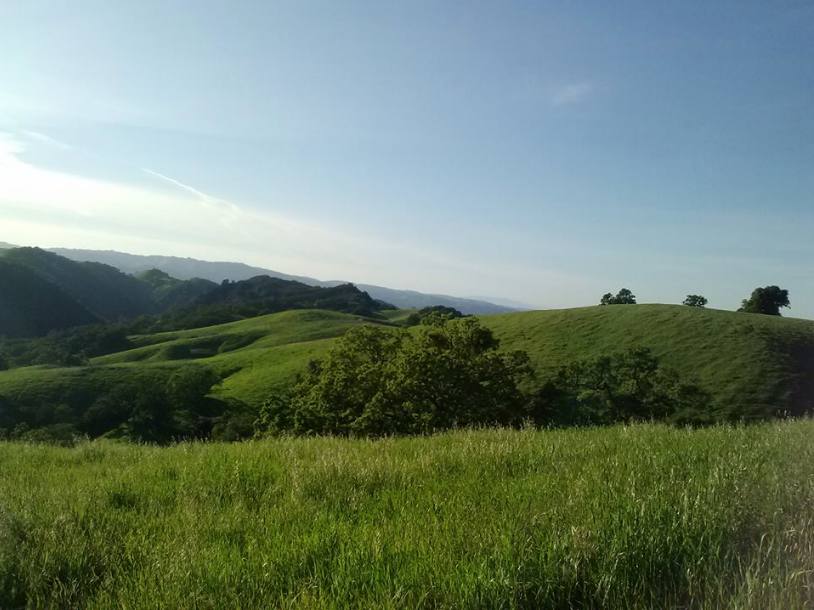
Photo above: Green spring foothills in Mount Diablo State Park, March 2016. Dolphinelle, CC BY-SA 4.0, via Wikimedia Commons.

Nearly every Clayton home pays two city parcel taxes on top of the regular property tax: $312.84 for the citywide landscape district and $26.05 for the downtown park, both for fiscal year 2026-27. Many homes also pay a streetlight assessment, and homes in the Oakhurst geologic hazard district pay a separate yearly charge of $114.47 to $341.55.
The landscape tax is on the November 3, 2026 ballot as Measure N, and a new city sales tax is on the same ballot as Measure M. Here’s what each charge is, what it pays for, and what changes under Measures M and N, all from the City of Clayton’s own documents.
What is the Clayton landscape district tax?
It’s a special parcel tax that pays for public landscaping, trails and open space weed abatement across the city. The official name is Community Facilities District 2007-1, the Citywide Landscape Maintenance District. For 2026-27 it’s $312.84 per residential parcel, and non-residential property pays $312.84 per acre or part of an acre (City Attorney’s Impartial Analysis of Measure N, August 2026).
The city’s annual report counts 4,063 residential parcels paying the full rate this year (NBS, CFD 2007-1 Annual Report, June 2026). Voters last renewed it with Measure H on June 7, 2016, with 79.23% voting yes. That authority ends June 30, 2027.
The city lists what the tax maintains: about 2 million square feet of roadway landscaping and irrigation, 515 acres of open space, 2,871 street trees, 27 miles of public trails and the Clayton Fountain at Oakhurst Boulevard and Clayton Road. It does not pay for The Grove, Clayton Community Park, Lydia Lane Park, Stranahan Park or North Valley Park. It also does not pay for your own yard, your fire insurance, Oakhurst GHAD work, police or the library (City of Clayton, Measure N FAQ #2, Question 6).
What would Measure N change?
Measure N asks voters to keep the landscape tax for ten more years, through June 30, 2037, at a higher starting rate. If it passes, the tax becomes $354.45 per residential parcel on July 1, 2027. That’s $41.61 more than today, about 13.3%. Starting July 1, 2028, the City Council could raise it each year by the Consumer Price Index, capped at 3%, after a recommendation from the Trails and Landscaping Committee (Impartial Analysis of Measure N; Measure N FAQ #2, Question 10).
It needs two-thirds of the votes to pass. If it fails, the current tax ends June 30, 2027 and no district tax is collected in 2027-28. The city says no replacement plan has been adopted for that case (Measure N FAQ #2, Questions 3 and 15).
The city’s ten-year math for one residential parcel:
| City’s illustration | Final-year rate | Ten-year total |
|---|---|---|
| No increases after July 1, 2027 | $354.45 | $3,544.50 |
| The 3% maximum every year | about $462.48 | about $4,063.37 |
The city calls the second row a maximum, not a forecast (Measure N FAQ #2, Question 11).
Is Measure M a property tax?
No. Measure M is a 1% city sales tax. It would raise Clayton’s sales tax rate from 8.75% to 9.75% starting April 1, 2027, with no end date unless voters repeal it. It needs a simple majority. The city estimates about $1,000,000 a year for the General Fund, which can be spent on any lawful city purpose (Impartial Analysis of Measure M; Measure M FAQ #2, Questions 5 and 6).
It doesn’t show up on your property tax bill. You’d pay it on taxable purchases, and most groceries bought to eat at home are generally exempt, per the city’s FAQ. The city also notes that a separate regional transit measure could change Clayton’s sales tax rate if it passes.
What does the downtown park tax pay for?
It pays to run and maintain the roughly one-acre public park between Main and Center Streets downtown, the park the city calls The Grove. The official name is Community Facilities District 2006-1. For 2026-27 it’s $26.05 per residential parcel, levied on 4,066 residential parcels, and it runs through fiscal year 2036-37 under Measure P, which voters approved in November 2014 with 81.25% as an extension of the earlier Measure O (NBS, CFD 2006-1 Annual Report, June 2026). Measures M and N don’t touch it.
Does my Clayton home pay the Oakhurst GHAD fee?
Only if it sits inside the Oakhurst Geologic Hazard Abatement District. The GHAD pays for landslide and erosion prevention, drainage upkeep and weed abatement on its slopes. It has three areas: Area 1 is the Indian Wells neighborhood, Area 2 is Keller Ridge and Area 3 is Peacock Creek (Oakhurst GHAD Engineer’s Report, FY 2026-27, July 7, 2026).
The 2026-27 maximum yearly assessments:
| Where the home is | 2026-27 assessment |
|---|---|
| Outside the GHAD | $0 |
| Area 1, single-family home on a public street, or condo on a private street | $114.47 |
| Area 1, single-family home on a private street | $143.09 |
| Area 2, single-family home or condo | $304.57 |
| Area 3, single-family home | $341.55 |
Source: Oakhurst GHAD Engineer’s Report, FY 2026-27, Table 5. The City Council also sits as the GHAD board, but the GHAD has its own budget. Neither Measure M nor Measure N changes it (Measure N FAQ #2, Question 14). The city posts the district’s December 2025 reconnaissance report on its Special Districts page, so you can read what work is planned on the slopes near a home you like.
What other Clayton assessments can show up on a tax bill?
A few smaller ones, depending on the street:
- Streetlights. Per-lot amounts for 2026-27 run from $8.34 to $43.54. Most single-family subdivisions on public streets pay $43.54. A few, including Peacock Creek, Falcon Ridge I and Stranahan, pay $33.38. Condos, duets and homes on private streets pay $8.34 to $31.28 (Streetlight Assessment District Engineer’s Report, FY 2026-27, July 7, 2026).
- Sewer districts. Oak Street Sewer charges its final assessment in 2026-27. Lydia Lane Sewer, for the Lydia Lane and Verna Way area, runs through 2031-32 (City of Clayton, Special Districts page).
- Bridges. The High Street (formed 1999) and Oak Street (formed 2000) permanent road divisions were set up so the homes in them repay the city for rebuilding those bridges over Mitchell Creek, with part of each levy set aside for upkeep (City of Clayton, Special Districts page).
- Diablo Estates. The 24 lots in Diablo Estates pay a benefit assessment for storm drains, landscaping, private street lighting and slope weed abatement (same source).
Your bill can also carry charges from agencies other than the city. Read every line.
How much does that add up to?
It depends on the parcel. Here’s our own math from the city’s 2026-27 reports, for two example single-family homes on public streets:
| Example home | Landscape | Downtown park | Streetlights | Oakhurst GHAD | Total, 2026-27 |
|---|---|---|---|---|---|
| Outside the GHAD, $43.54 streetlight rate | $312.84 | $26.05 | $43.54 | $0 | $382.43 |
| Peacock Creek (GHAD Area 3) | $312.84 | $26.05 | $33.38 | $341.55 | $713.82 |
Treat those as examples, not your bill. The only number that counts is the one on the home’s own tax bill.
How do I check a Clayton home’s tax bill?
Look it up before you write an offer. Put the address or parcel number into the Contra Costa County Treasurer-Tax Collector’s property tax lookup (taxcolp.cccttc.us) and read each special tax and assessment line. Ask the seller for the most recent bill too.
Because the landscape and downtown park taxes are Community Facilities District (Mello-Roos) taxes, California requires sellers to make a good faith effort to get the agencies’ disclosure notices and hand them to the buyer (Civil Code 1102.6b). Your escrow officer will see the charges in the title report.
We explain what the charges are. For what they mean for your own taxes or budget, talk to a tax professional. For legal questions on disclosures, ask a real estate attorney.
How can I learn more before I vote?
Go to the source. The city’s Measure M and Measure N pages post the ballot language, the City Attorney’s impartial analyses, the arguments for and against each measure, and the rebuttals. The city holds a second town hall on Wednesday, October 7, 2026, 6 to 8 pm, at Hoyer Hall in the library building, 6125 Clayton Road (City of Clayton news, Town Hall Meetings). We don’t take a side on either measure. That’s your call.
Questions people also ask
How much is the Clayton landscape tax?
It’s $312.84 per residential parcel for fiscal year 2026-27, and non-residential property pays $312.84 per acre or part of an acre, per the City Attorney’s impartial analysis of Measure N. It appears as a line on the Contra Costa County property tax bill. The current authority ends June 30, 2027 unless voters extend it on November 3, 2026.
What happens if Measure N fails?
The current landscape tax ends June 30, 2027, and no district tax would be collected in fiscal year 2027-28, according to the City of Clayton’s Measure N FAQ #2. The city says no replacement plan has been adopted. Future City Councils would decide in the budget process whether other money goes to landscaping, trails and open space weed abatement.
Does Measure M raise my property taxes?
No. Measure M is a 1% city sales tax, not a property tax. If a majority approves it, Clayton’s sales tax rate goes from 8.75% to 9.75% starting April 1, 2027, per the City Attorney’s impartial analysis. You’d pay it on taxable purchases. Most groceries bought for home are generally exempt, according to the city’s FAQ.
Which Clayton neighborhoods are in the Oakhurst GHAD?
The Oakhurst Geologic Hazard Abatement District has three areas: Indian Wells (Area 1), Keller Ridge (Area 2) and Peacock Creek (Area 3), per its FY 2026-27 engineer’s report dated July 7, 2026. The 2026-27 assessments run from $114.47 to $341.55 a year. Homes outside the district pay nothing. Check the tax bill for any specific address.
Your next step
Found a Clayton home you like? Send us the address. We’ll pull its tax bill, flag every special tax and assessment on it, and show you what Measure N would change on that exact parcel. Talk to an agent on our team or call (510) 949-5525.
More on Clayton: Is Clayton a good place to live? · Selling a home in Clayton · What’s my home worth?
By Bill Davis, DRE #01880656, The Davis Team at eXp Realty, Clayton, CA. Updated September 25, 2026.
Sources
- City of Clayton, City Attorney’s Impartial Analysis of Measure N, August 2026: claytonca.gov/DocumentCenter/View/844 (checked September 25, 2026)
- City of Clayton, City Attorney’s Impartial Analysis of Measure M: claytonca.gov/DocumentCenter/View/841 (checked September 25, 2026)
- City of Clayton, Measure N FAQ #2, Questions 1 to 15: claytonca.gov/DocumentCenter/View/872 (checked September 25, 2026)
- City of Clayton, Measure M FAQ #2: claytonca.gov/DocumentCenter/View/873 (checked September 25, 2026)
- City of Clayton, Measure M and Measure N pages: claytonca.gov/342 and claytonca.gov/343 (checked September 25, 2026)
- NBS, Fiscal Year 2026/27 Annual Report, CFD No. 2007-1 Citywide Landscape Maintenance Tax, June 2026: claytonca.gov/DocumentCenter/View/772 (checked September 25, 2026)
- NBS, Fiscal Year 2026/27 Annual Report, CFD No. 2006-1 Downtown Park Operation and Maintenance Tax, June 2026: claytonca.gov/DocumentCenter/View/763 (checked September 25, 2026)
- Francisco and Associates, Oakhurst Geologic Hazard Abatement District Engineer’s Report, FY 2026-27, July 7, 2026: claytonca.gov/DocumentCenter/View/752 (checked September 25, 2026)
- Francisco and Associates, Streetlight Assessment District Engineer’s Report, FY 2026-27, July 7, 2026: claytonca.gov/DocumentCenter/View/760 (checked September 25, 2026)
- City of Clayton, Special Districts: claytonca.gov/189/Special-Districts (checked September 25, 2026)
- City of Clayton news, Town Hall Meetings: claytonca.gov/CivicAlerts.aspx (checked September 25, 2026)
- Contra Costa County Treasurer-Tax Collector, property tax lookup: taxcolp.cccttc.us (checked September 25, 2026)
- California Civil Code 1102.6b: leginfo.legislature.ca.gov (checked September 25, 2026)