
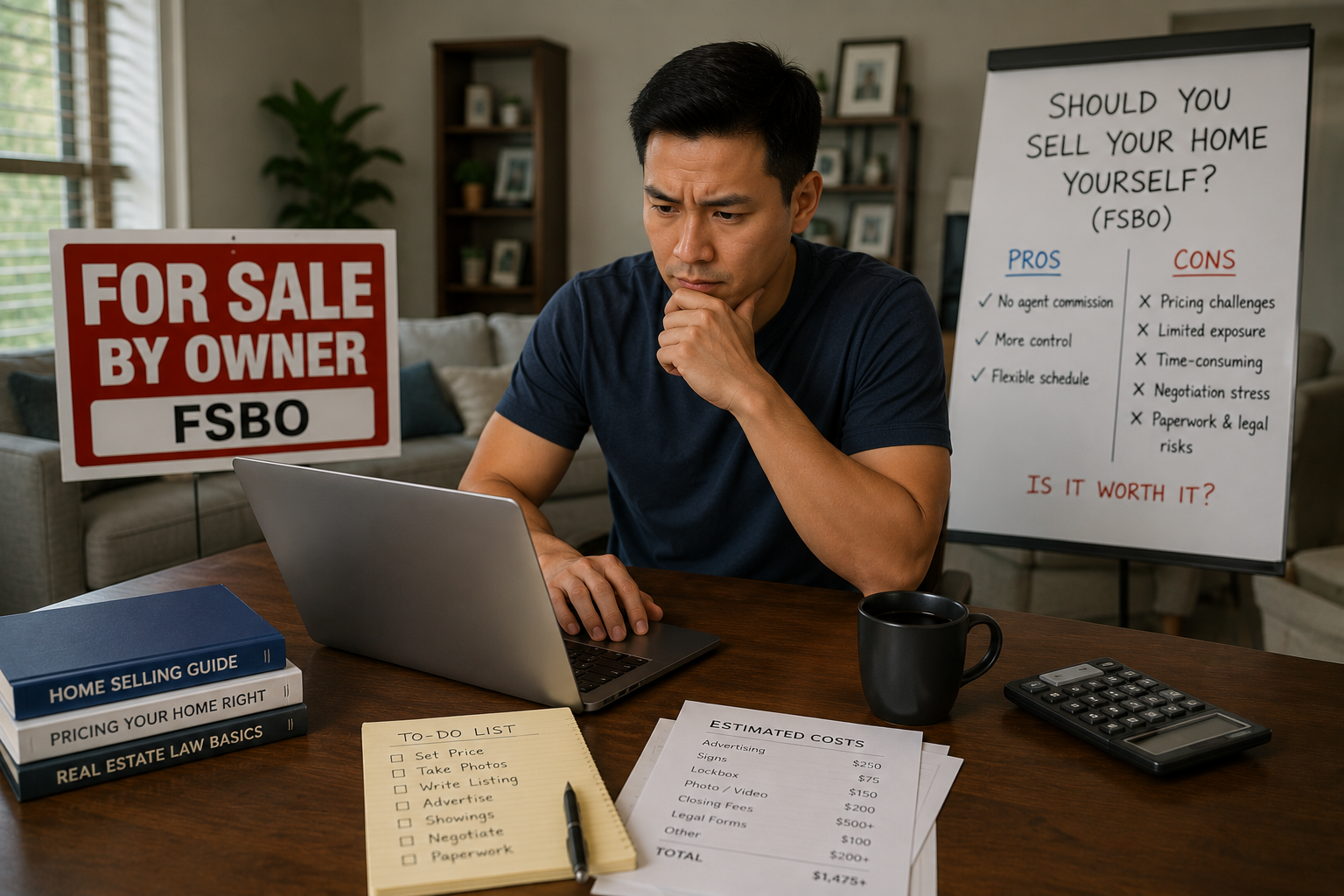
If you are thinking about selling your home yourself, you are asking a perfectly reasonable question.
After all, real estate commissions are not small. When you look at the value of your home and calculate what you might save by avoiding agent fees, it is easy to see why the idea of For Sale By Owner, commonly called FSBO, is appealing.
This is one of those topics where homeowners deserve an honest answer, not a sales pitch.
The reality is that some sellers absolutely can sell a home on their own. There are situations where it works well. There are also situations where trying to save a commission ends up costing far more than the commission itself.
The goal here is not to convince you one way or the other. It is simply to help you understand the tradeoffs so you can make the decision that is best for your situation.
The biggest attraction of FSBO is obvious. You keep more of the proceeds from your sale.
For many homeowners, that savings can feel significant. If your home sells for hundreds of thousands of dollars, the commission expense is a real number. It is natural to wonder whether you can handle the process yourself and keep that money in your pocket.
And sometimes the answer is yes.
FSBO tends to work best when the transaction is unusually simple. Maybe you already have a buyer lined up. Maybe you are selling to a family member, friend, neighbor, or someone you already know and trust. Perhaps you have experience buying and selling real estate and feel comfortable handling contracts, negotiations, disclosures, and timelines.
In those situations, selling on your own can make sense.
The challenge is that most home sales are not that straightforward.
A typical home sale involves pricing strategy, marketing, buyer psychology, negotiations, inspections, financing contingencies, appraisals, disclosures, legal paperwork, and dozens of moving parts that have to stay coordinated from listing day all the way to closing.
That is where the conversation becomes more interesting.
When people discuss FSBO, they often focus exclusively on commission savings. What is discussed less often is the final sales price.
According to data that has been reported over the years by industry and market studies, FSBO homes typically sell for less than agent-represented homes. The exact difference varies by market and year, but the pattern tends to be consistent.
Why does that happen?
It is usually not because homeowners are incapable of selling their property.
More often, it comes down to exposure, pricing strategy, and negotiation leverage.
A home that reaches fewer buyers generally receives fewer offers. Fewer offers typically means less competition. Less competition often translates into a lower final sales price.
Pricing is another major factor. Many FSBO sellers accidentally overprice their homes because they are emotionally attached to the property or because they rely on online estimates that do not fully account for local market conditions. Others underprice the home and leave money on the table without realizing it.
Either mistake can be expensive.
When you compare the average difference in sales price to the commission that was saved, many sellers discover that they may have been financially better off hiring representation.
That does not mean every FSBO seller loses money. Some do very well. But it does mean the conversation should focus on net proceeds, not just commissions.
The real question is not, "How much commission can I save?"
The real question is, "How much money will I actually walk away with after everything is complete?"
That brings us to another important point: what exactly does an agent do?
Many people understandably assume an agent's primary role is putting a home on the MLS and waiting for buyers to appear.
The reality is much broader than that.
A good agent starts with pricing. This is not simply pulling comparable sales and picking a number. It involves understanding buyer demand, inventory levels, market trends, neighborhood dynamics, financing realities, and buyer behavior.
Pricing correctly can create momentum. Pricing incorrectly can cause a listing to sit on the market while buyers wonder what is wrong with it.
Marketing is another major component.
Professional photography, online exposure, MLS distribution, social media promotion, agent networks, email marketing, open houses, and buyer outreach all help create visibility. The goal is not just getting the property seen. The goal is getting it seen by the right buyers.
Then there is negotiation.
Most sellers think negotiation begins when an offer arrives. In reality, negotiation starts much earlier.
How do you respond to low offers?
How do you handle inspection requests?
What happens when an appraisal comes in below contract price?
How do you navigate repair credits, closing costs, contingencies, extensions, and financing issues?
Experienced agents deal with these situations regularly and understand how to keep transactions moving while protecting their clients' interests.
There is also the compliance side of the transaction.
Disclosures, contracts, deadlines, amendments, addendums, inspections, title work, escrow coordination, and lender communication all require attention to detail. Missing something important can create delays, disputes, or liability after closing.
Most transactions encounter at least one unexpected issue before they reach the finish line.
Part of an agent's value is knowing how to solve those problems quickly.
The risks of selling alone are often hidden until they become expensive.
Mispricing is probably the most common one.
A home priced too high can sit for weeks or months. Eventually price reductions become necessary, and buyers begin to wonder why the property has not sold. Momentum is lost.
A home priced too low may attract immediate interest, but the seller may never know how much money they left behind.
Limited exposure is another concern.
The fewer buyers who see the property, the fewer opportunities there are to create competition. In real estate, competition is often what drives the strongest outcomes for sellers.
Legal exposure is also worth considering.
Real estate laws vary by state. Disclosure requirements, contract language, timelines, and procedural requirements can be more complicated than many homeowners expect. Even honest mistakes can create problems later.
Finally, there is negotiating position.
Professional buyers, investors, and experienced agents negotiate real estate transactions every day. A homeowner who only sells a house once every several years may find themselves at a disadvantage when discussions become complicated.
With all of that said, there are absolutely situations where FSBO is a smart choice.
If you already have a committed buyer and both parties agree on price and terms, the transaction may be simple enough that agent representation provides less value.
If you are selling to a family member, business partner, tenant, or close acquaintance, many of the marketing and exposure benefits become less important.
Similarly, if a reputable cash investor approaches you with an offer that meets your goals, you may decide that speed and simplicity outweigh the need for broader market exposure.
Those situations exist, and there is nothing wrong with choosing the route that makes the most sense for your circumstances.
The key is making that decision based on a full understanding of the numbers rather than focusing on commission alone.
At the end of the day, selling a home is not about minimizing fees. It is about maximizing your outcome.
Sometimes that means selling yourself.
Sometimes that means hiring professional representation.
The best choice depends on your goals, your timeline, your experience level, and the specifics of your property.
If you are considering FSBO and want an honest comparison, I would be happy to help. No pressure. No obligation. Just a straightforward conversation about what your home might realistically sell for, what your net proceeds could look like with and without an agent, and which path is likely to put the most money in your pocket.
The right answer is not always the same for every seller. The important thing is knowing the numbers before you decide.
Check out this article next